

From Intent to Offer: A Smarter Commercial Real Estate Investment Strategy with the Right Commercial Realtor®
If you’re exploring commercial real estate investing as a way to diversify your portfolio, create long-term income, or gain more control over your capital, this guide will walk you through the critical early decisions. With insights from experienced Commercial Realtors®, it outlines how to move from intention to action with a clear income property investment strategy.
Many investors are drawn to commercial real estate investing for its long-term stability, income potential, and the ability to directly control how capital is put to work. But like any investment, it carries risk. Regulatory changes, market shifts, financing conditions, and tenant turnover can all affect performance. What you buy, how you finance it, and the assumptions you build into your plan matter more than most people expect.
The questions you ask at the outset, and the choices you make early on, shape the kind of investment you end up with, how well it performs, and how confident you feel moving forward.
What outcome am I really aiming for — and over what timeline?
How should I allocate capital to support both the acquisition and its performance?
What needs to be in place before approaching lenders and sellers?
How do I present my financial position in a way that strengthens my offer?
What advisors do I need — and when?
And most importantly: is commercial real estate likely to deliver the return that fits my long-term strategy, or am I pursuing the wrong investment altogether?
If you’ve been thinking about diversifying your portfolio, building long-term wealth, or creating income outside the stock market, it’s worth asking whether commercial property is the right fit — not just in theory, but for you.
This article outlines what happens at the front end of the commercial real estate investment and acquisition process — and how we help buyers move from early interest to a well-positioned offer with a clear income property investment strategy.
To see how the pieces fit together, here’s a simple framework that distills the process into five clear steps. Think of it as a map you can reference as your strategy develops.
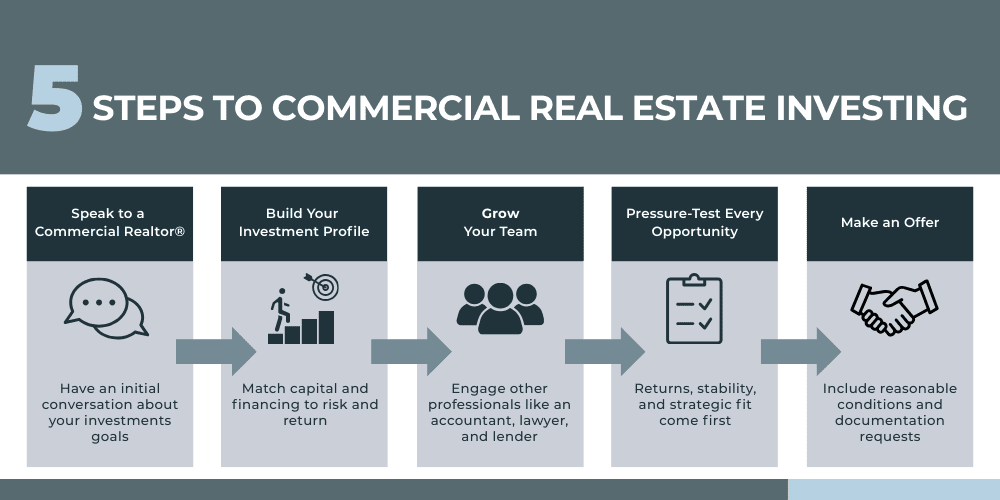
Five essential steps to smarter commercial real estate investing. From defining your goals and shaping your financial plan to building your advisory team, pressure-testing opportunities, and structuring the offer, this infographic illustrates how a trusted Commercial Realtor® can help guide a disciplined income property investment strategy that builds long-term value.
Knowing the steps is one thing—knowing how to act on them is another. Who to involve, what to prioritize, when to move, and how to structure the early conversations all determine how your commercial real estate investing strategy develops. The next step is deciding where to begin, and that starts with your very first conversations.
Starting the Conversation: Who to Speak With — and When
Once you’ve decided this might be the right direction, the next question is: who should you speak with first?
Most investors assume it’s their bank, lawyer, or accountant — and eventually, yes, all three will play important roles. But none of them are focused on the big picture of the asset, the strategy, and how the two align.
This is where a Commercial Realtor® comes in — ideally, one who understands the investment beyond the purchase.
This first conversation is about more than spotting listings. It’s where you frame your objectives, pressure-test different property types, and determine how much capital you’ll need to deploy — and when. It’s not about chasing opportunities. It’s about being ready for the right one.
This is where our role as your Commercial Realtor® often looks a little different. We are focused not only on the purchase, but on building a commercial real estate investing strategy that performs for you over the long term.
Framing the Investment: What the Numbers Need to Tell You
Once your goals are in view, the next step is shaping the financial plan that supports them. That means more than defining how much you’re prepared to spend — it’s about how your capital is structured, where it’s coming from, and how it will be put to work.
This is where we continue the conversation in our role as your Commercial Realtor®, grounded in a broader commitment to helping you build an investment that aligns with your goals.
And here’s the more fundamental question your numbers should help answer:
Does this investment make sense to me — not just financially, but in terms of risk, effort, and timeline?
Each asset class brings a unique mix of return potential, volatility, and level of involvement. In commercial real estate investing, a fully leased industrial building may provide stable income with minimal oversight. In contrast, a mixed-use property or underperforming retail strip could offer value-add potential but with greater complexity and risk.
We’ll help you map out:
- Capital available for down payment, closing costs, and reserves
- Financing approach and readiness to engage with a lender
- Comfort with carrying costs, including vacancies or immediate improvements
- Whether your corporate structure is in place or needs to be established
- How the asset class aligns with your return expectations, time horizon, and risk profile
At this stage, your plan is taking shape. You’ll begin to recognize which properties align with your objectives, which do not, and where your capital has the potential to make the greatest impact.
Assembling Your Team: From Conversations to Commitments
Once your goals are defined and your plan begins to take form, the next step is building the financial structure to support both. That means more than deciding how much you’re prepared to spend. It’s about understanding how your capital is organized, where it will come from, and how it will be deployed.
- Your accountant is often the first to join the conversation. They’ll help decide whether to buy personally or through a company, structure the investment for tax efficiency, and align it with your broader financial picture. If you’re pursuing financing, they will also need to prepare income or corporate details.
- Your lender comes in once your capital, target range, and risk tolerance are clear. Being pre-positioned with a banker or broker builds credibility and speeds things up when the right opportunity appears.
- Your lawyer steps in as you prepare an offer. If corporate cleanup or structuring is needed, bring them in earlier. While your commercial realtor will draft the offer of purchase and sale document, your lawyer will review terms, advise on risk, and finalize documents for closing.
This doesn’t all need to happen at once. But bringing the right professionals in at the right time helps maintain momentum, supports informed decisions, and gives your offer the weight it needs to move forward with confidence.
Filtering the Field: What a Good Opportunity Really Looks Like
With your financial framework in place and your team coming together, the search becomes more focused and more productive. This is no longer about scanning listings for inspiration. Now, it’s about identifying viable opportunities that align with your strategy, your risk profile, and your financial structure – key elements that determine long-term success in commercial real estate investing.
This is often where overconfidence or personal bias can creep in, especially when first impressions do not match expectations. We explored this in more depth in our blog on commercial real estate decision-making and the Dunning-Kruger effect, and it’s worth keeping in mind as you refine your shortlist.
Each property should be evaluated as a business case, not a personal trophy, not a reflection of status, and not someone else’s idea of the perfect investment. Ego cannot drive the decision. The right asset for you might not be pretty or new, but if it could deliver the target return, it is worth serious consideration.
We’ll help you assess:
- Net income, cap rates, and projected returns
- Lease structures, tenant strength, and rollover timelines
- Vacancy exposure and controllable operating costs
- Any red flags — deferred maintenance, unusual expense patterns, or inconsistent reporting
Here’s a hard truth: the perfect property probably doesn’t exist. Each decision point involves give and take.
You’ll almost always be weighing trade-offs: tenant quality and location, return and stability, purchase price and future investment needs. What matters is knowing your priorities and staying focused on your investment target. This is where strategy and discipline come in. By now, you should have a clearer sense of what fits, what doesn’t, and where it makes sense to compromise.
Structuring the Offer: Protection, Positioning, and Pace
Once a property has been filtered through your investment criteria, and the numbers, risks, and tradeoffs make sense, it’s time to move forward with an offer of purchase and sale. This is where your strategy becomes contractual terms on paper: clear, enforceable, and designed to protect your interests.
At this stage, your Commercial Realtor® plays a critical role in helping you move from planning into action. And this is where having the right one makes a meaningful difference in the success of your commercial real estate investing strategy. We guide you through:
- Which buyer conditions to include, such as financing, document review, and environmental or structural due diligence, and how long you’ll reasonably need to satisfy them
- What documentation you’re entitled to review, such as leases, estoppel certificates, rent rolls, service contracts, and operating cost data
- What timelines and deposits are typical in this type of transaction — and how to avoid unnecessary delays
- When to bring in your lawyer and accountant to finalize the structure and legal language
A well-structured offer of purchase and sale does three things:
- Protection — it gives you the time and access needed to confirm the fundamentals: leases, financials, physical condition, and operating costs.
- Positioning — it signals to the seller that you’re serious, prepared, and realistic about the process.
- Pace — it sets a professional tempo — one that moves the deal forward, reduces uncertainty, and gives the seller confidence that you can and will close.
And that often matters more than the price.
Sellers don’t always choose the highest offer. They choose the one most likely to reach the finish line. Many deals fall apart during due diligence because buyers were not fully prepared. That costs time, momentum, and money. Most experienced sellers have learned to recognize the warning signs.
Your offer should reflect strength, credibility, and clear intent. At the same time, it must give you the ability to step back if key elements do not hold up under review.
Due Diligence and Closing: Verification and Confidence
Once the offer of purchase and sale is accepted, the process accelerates. This is when the clock starts ticking.
It is the stage where you confirm that what has been presented holds up under review. That includes verifying lease terms, rent rolls, and estoppel certificates; confirming operating expenses; reviewing service contracts and warranties; and, if needed, commissioning environmental or structural assessments.
It is also when you will work with your lawyer to finalize title matters, entity structure, and closing documentation, as well as coordinate with your lender to secure and document financing.
The due diligence period gives you the opportunity to confirm the fundamentals or walk away if something material does not align with expectations. At the same time, it allows you to prepare for closing day with clarity and confidence.
Reaching the finish line means aligning the right professionals, timelines, and information. As your Commercial Realtor®, we will help you stay organized and in motion so the transition from accepted offer to closed deal feels like a natural next step rather than a last-minute scramble.
Long-Term Value in Commercial Real Estate Investing
Every strong commercial real estate investment is built on clarity, preparation, and long-term thinking. The decisions you make today establish the foundation for future performance and asset value.
This is where having the right Commercial Realtor® by your side makes a lasting difference. Ongoing property management, reliable oversight, and a well-considered approach to tenant relationships are essential to protecting your income property investment strategy and keeping it aligned with your long-term goals.
If you already own a commercial real estate investment and suspect it could be performing better, we can help evaluate what is holding it back and how to unlock greater value. Often, it is not the property itself—it is the investment strategy behind it.
Smart commercial real estate investing does not end at closing, and neither does our support. We help turn sound commercial real estate acquisitions into performing assets and underperforming properties into stronger investments, often through a proactive commercial property management strategy that aligns with your long-term investment goals.
Let’s talk about what your next smart move could look like.